
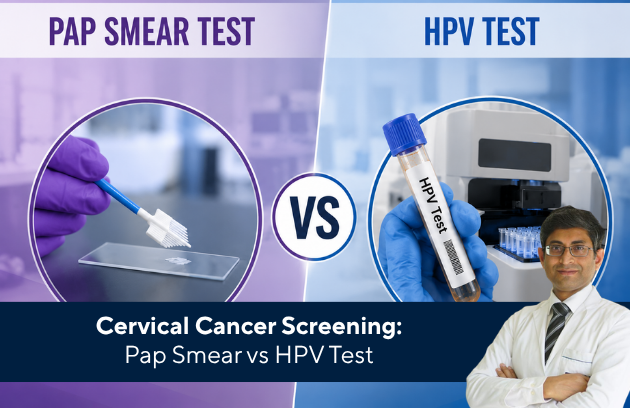
Cervical Cancer Screening: Pap Smear vs HPV Test
Cervical cancer kills 77,000 women annually worldwide, yet remains almost entirely preventable through screening. Many Indian women lack awareness about screening methods — or confuse outdated approaches with modern alternatives. Two primary screening pathways exist: the Pap smear and the HPV test. Understanding what each does and when to use it can save your life.
Dr. Dodul Mondal at Max Super Speciality Hospital, Saket, guides women through screening decisions daily. Early detection transforms cervical cancer into a manageable, curable disease.
What Is Cervical Cancer Screening?
Cervical cancer screening detects precancerous changes in cervical cells before they progress to invasive cancer. It identifies disease risk before symptoms appear, allowing early intervention when treatment is minimally invasive.
According to Best cervical cancer specialist in Delhi NCR, screening interrupts disease progression at the earliest stage, catching abnormalities while localised and highly treatable.
Why Screening Matters?
Nearly all cervical cancers result from persistent high-risk HPV infection (particularly HPV-16 and HPV-18). Up to 80% of women encounter HPV; most clear it naturally within 1–2 years. Persistent infection causes cervical intraepithelial neoplasia (CIN) — precancerous changes progressing to cancer over 5–10 years if undetected.
Screening’s advantage: abnormalities are detectable and treatable before invasive cancer develops, allowing disease prevention entirely.
The Pap Smear: Traditional Screening Explained
A cervical cytology test collects cells from the cervix surface using a brush or spatula, then examines them microscopically for abnormalities. The procedure takes under one minute with minimal discomfort.
| Result | Meaning | Next Step |
| Normal | No abnormal cells | Routine screening in 3 years |
| ASC-US | Atypical cells undetermined | Repeat Pap in 12 months or HPV reflex |
| LSIL | Low-grade intraepithelial lesion | Colposcopy |
| HSIL | High-grade intraepithelial lesion | Immediate colposcopy and biopsy |
Advantages: Long track record, inexpensive, widely accessible.
Limitations: Operator-dependent, 15–20% false-negative rate.
The HPV Test: Modern Screening Explained
HPV test detects genetic material (DNA) from high-risk HPV types in cervical cells, identifying whether the cancer-causing virus is present. Sample collection is identical to Pap — a one-minute procedure with molecular testing to identify HPV DNA.
| Result | Meaning | Next Step |
| HPV Negative | No high-risk HPV detected | Routine screening in 3–5 years |
| HPV Positive | High-risk HPV present | Reflex Pap or colposcopy per protocol |
Advantages: Higher sensitivity (95%+), objective results, longer intervals (3–5 years), superior negative predictive value.
Limitations: More expensive, detects virus not necessarily disease.
Pap vs HPV: Which Is Better?
HPV testing is more effective for cancer prevention, but both have roles. Neither is universally “best” — choice depends on age and history.
Screening recommendations in India:
Ages 21–29: Pap smear alone every 3 years acceptable. HPV testing may overdetect benign infections that naturally clear.
Ages 30–65: HPV testing alone every 5 years preferred, OR co-testing (Pap + HPV), OR Pap with HPV reflex.
Age 65+: Screening can discontinue if prior negative tests documented.
Understanding Your Results: Interpretation Guide
Abnormal Pap + Negative HPV = Low risk; repeat in 12 months.
Normal Pap + Positive HPV = Requires colposcopy.
Abnormal Pap + Positive HPV = Higher risk; colposcopy recommended.
Both tests negative = Excellent; continue routine screening.
Abnormal Results: What Happens Next?
If abnormal, colposcopy (magnified cervical examination, 5–10 minutes, not painful) identifies concerning areas. If found, a small tissue biopsy confirms grade of cervical intraepithelial neoplasia (CIN 1, 2, or 3).
Treatment: Minimally invasive outpatient procedures remove abnormal tissue: LEEP (Loop Electrosurgical Excision Procedure), cold-knife conization, or laser conization. Success rates: 90%+ in preventing cancer progression.
Frequently Asked Questions
Q1. Can I get cervical cancer if my Pap smear is normal? Yes, though rarely. Pap has 15–20% false-negative rate. HPV testing, with superior sensitivity, is increasingly recommended alongside or instead of Pap for women age 30+.
Q2. What does testing positive for HPV mean? HPV positivity means virus exposure. It does not mean cancer or certain future disease. Most women (90%+) clear high-risk HPV naturally within 2 years. Only persistent infection requires closer colposcopy monitoring.
Q3. Is HPV testing painful? No. Sample collection is identical to Pap — quick, minimally uncomfortable, under one minute. Light spotting afterward is normal.
Q4. At what age should I start cervical cancer screening? In India, screening typically begins at age 21 and continues through age 65. Discuss individual recommendations with your gynecologist if you became sexually active before age 21.
Q5. If my HPV test is negative, when should I be screened again? If HPV test is negative, cancer risk is low. Most guidelines recommend repeat screening in 3–5 years (not annually). However, abnormal vaginal bleeding or discharge warrants evaluation regardless of screening history.
When to Seek Help?
If overdue for screening or have abnormal results, consult your gynecologist for personalized guidance. Early specialist evaluation of abnormal findings is critical.
A best radiation oncologist in Delhi NCR specializing in gynecologic oncology can provide expert assessment. Dr. Dodul Mondal at Max Super Speciality Hospital, Saket, offers comprehensive cervical cancer screening counselling and advanced treatment options, including precision radiation therapy for diagnosed cervical cancer.
Conclusion
Cervical cancer screening has saved millions of lives. Both Pap and HPV testing represent powerful prevention tools — choice depends on age, history, and individual risk. What matters most is regular screening with appropriate follow-up if abnormalities are detected.
Cervical cancer remains largely preventable through early detection. The opportunity to interrupt disease progression exists — but only if screening occurs. If overdue for screening, make your appointment today. Early detection saves lives.
Dr. Dodul Mondal is a leading Best cervical cancer specialist in Delhi NCR with specialized expertise in early detection screening protocols and advanced radiation oncology treatment for gynecologic malignancies. For screening counselling or expert evaluation of abnormal results, contact Max Super Speciality Hospital, Saket.